From McElroy Metal’s roof owner’s manual and the Metal Roofing Alliance.
Metal roof maintenance comes down to five jobs: an inspection once a year and after storms, keeping gutters, valleys and the roof surface clear, checking fasteners and trim, cleaning gently when the roof gets dirty, and keeping copper, lead and other metals that corrode steel away from it. A metal roof is low-maintenance, not no-maintenance, and that small amount of care is what lets it reach its full life.
We are the Afford-A-Pro team in Jasper. We install standing seam and ribbed panel metal roofs across the Sequatchie Valley and maintain them afterward. This guide covers what to do, how often, and which jobs to leave to a roofer, with the manufacturer guidance behind each step. For our installation work, see our metal roofing page.
In this guide
- Standing seam vs exposed fastener: different upkeep
- A metal roof maintenance schedule
- How to clean a metal roof
- Fasteners, washers and trim
- Scratches, rust and dissimilar metals
- Why caulk is not a metal roof repair
- Should you walk on a metal roof?
- Metal roof maintenance questions
Standing Seam vs Exposed Fastener: Different Upkeep
Not every metal roof needs the same attention. The metal roofs we install are steel panels, in one of two systems:
- Standing seam panels join at raised seams, and the fasteners sit under the panel, out of the weather. With nothing piercing the face of the roof, there is less to maintain. Standing seam systems have a lifespan of 40 to 70 years.
- Ribbed panel, also called exposed fastener, is screwed through the face of the panel. The screws and their rubber washers age over time and should be checked and tightened during routine maintenance. That is the main extra job on this kind of roof.
Either way, the parts that need watching are the same: the trim at the ridge, rakes and eaves, the flashing around chimneys, vents and pipes, and the gutters and valleys that carry the water off.
A Metal Roof Maintenance Schedule
| Task | How often | Who |
|---|---|---|
| Inspect panels, trim, flashing and fasteners | Once a year at minimum | A roofer |
| Check after high wind, hail, heavy rain, ice or snow | After each event | You from the ground, then a roofer |
| Clear gutters, downspouts and valleys | Spring and fall; more under trees | You from a ladder, or a roofer |
| Remove branches and debris from the roof | As needed | A roofer for anything on the roof |
| Wash off dirt | When it looks dirty | You or a roofer |
| Check exposed fasteners and washers | At each inspection | A roofer |
| Look the roof over after other trades work on it | Each time | A roofer |
Inspection timing from McElroy Metal’s roof owner’s manual, which lists inspections annually at minimum and after severe weather or work by other trades.
McElroy gives a short list of what to look for after each kind of storm:
- High wind: debris, loose flashing, punctures and loose fasteners.
- Hail: punctures, damaged trim and loose fasteners.
- Heavy rain: water ponding on the roof, in the gutters or upslope of curbs and pipes.
- Ice or snow: damaged trim, pipes, gutters and snow guards from sliding ice.
If you suspect hail, our guide to a hail damage roof inspection explains what dents on metal look like.
How to Clean a Metal Roof
Most metal roofs only need rain to stay clean, but pollen, dirt and the leaf stain that builds up under trees can dull the finish. The Metal Roofing Alliance gives a simple routine:
- Clean out the gutters and downspouts and get any large debris, like branches, off the roof.
- Spray away ordinary dirt with a garden hose. Never use a power washer.
- For more stubborn dirt, mix about 1/4 cup of mild detergent (dish soap, car-wash soap or a mild laundry detergent) per gallon of water.
- Use the lightest touch that does the job, and let the solution sit for 5 to 10 minutes.
- Rinse the surface thoroughly with plain water.
Never use steel wool, wire brushes, scouring powders, paint removers or thinners on the panels; they damage the finish that protects the steel. The alliance also says to follow the panel manufacturer’s instructions, which protect the warranty. If the roof is steep, high or wet, wash what you can reach from a ladder at the eave and leave the rest to a roofer.
Fasteners, Washers and Trim
On a ribbed panel roof, each screw seals through a rubber washer. Over the years the washers age, so the screws should be checked and tightened during routine maintenance.
A screw that has stripped its hole is not simply tightened. McElroy’s manual says to remove it, put butyl sealant into the hole and drive an oversize, long-life fastener. Ridge cap, rake trim and the flashing around chimneys and pipes get the same look, because trim and flashing are where water most often finds its way in.
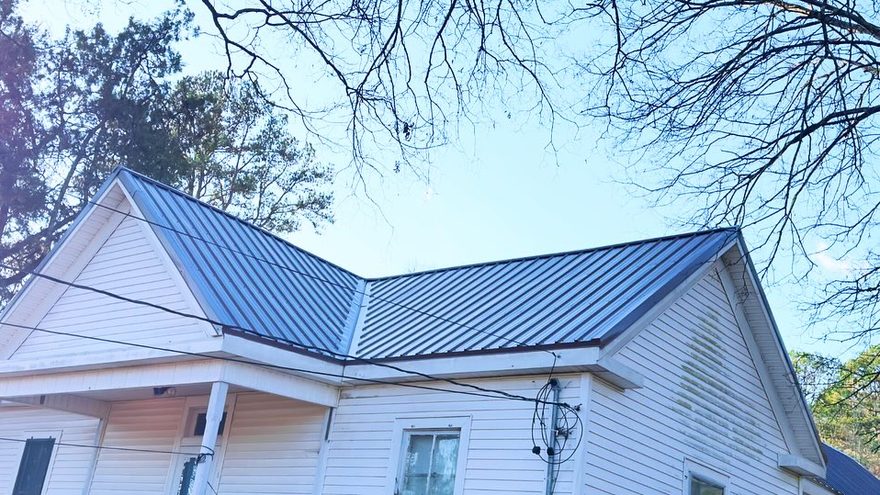
Branches like the ones above are worth trimming back. Leaves and twigs collect in valleys and behind chimneys, hold moisture against the metal and slow the water down. McElroy notes that anything that traps or holds moisture on a metal roof will cause premature corrosion.
Scratches, Rust and Dissimilar Metals
The painted or Galvalume coating is what protects the steel, so scratches deserve attention:
- Scratches in the paint. McElroy says to clean the spot with mineral spirits, rinse and dry it, and apply the smallest amount of touch-up paint that fills the scratch with a small artist’s brush, using only the manufacturer’s touch-up paint. Heavy touch-up shows more than the scratch.
- Rust stains. A mild cleanser on a soft cloth can lift some staining, then rinse. No product removes rust stains completely, so the goal is to stop the cause.
- Dissimilar metals. Copper, lead, graphite and mortar or cement corrode a steel roof, by contact or by the water running off them. McElroy lists the usual culprits: lead pipe flashings, copper lightning rods and cable, copper trim, an old copper gutter draining onto the roof, and air conditioner condensate, which carries dissolved copper. Pipe condensate lines to the gutter instead.
- Debris from other work. Drill shavings, wire and metal scraps left by satellite, solar or HVAC installers rust on the roof and stain it. Have the roof swept after anyone works up there.
Why Caulk Is Not a Metal Roof Repair
A common shortcut on a leaking metal roof is a bead of caulk or roof cement smeared over the spot. McElroy’s manual is blunt about it: surface-applied caulks and compounds eventually lose their bond, water gets trapped between the patch and the panel, and that causes severe corrosion.
The right repair at a panel or trim joint is to take the joint apart and reinstall the proper sealant between the metal layers. A puncture may need a new panel. If your roof is leaking, our roof repair crew fixes leaks and loose fasteners on metal and shingle roofs.
Should You Walk on a Metal Roof?
Usually not. Metal is slippery, especially wet, frosty or on a steep pitch. McElroy’s manual says walking on a metal roof can be dangerous, calls for fall protection, and says to step only in the flat of the panel near a support, never on the ridge, rake or gutter trim.
Heavy foot traffic can also leave black burnish marks on bare Galvalume and, on low-pitched roofs, create low spots where water ponds. Do your checks from the ground or a ladder at the eave, and let a roofer handle anything on the roof itself.
The same goes for snow and ice: never use metal tools to clear it, because they damage the coating.
Metal Roof Care in the Tennessee Valley
Our weather tests metal in its own way: hot, humid summers, spring storms with hail and high wind, and winter freeze-thaw cycles that work at every weak spot in the flashing. Homes and cabins under hardwoods and pines collect leaves and needles in valleys and gutters, even though metal sheds them better than shingles. We recommend a fall maintenance visit for most homes, before winter weather arrives, and twice a year for roofs in heavily wooded spots. Our roof maintenance checklist covers the rest of the house, and our guide to metal roofing cost helps if you are weighing a new roof instead.
We maintain and repair metal roofs in Jasper, Sequatchie, Powells Crossroads, Monteagle and across the valley. To set up a visit, see our metal roofing services or use the form on this page.
Metal Roof Maintenance Questions
Does a metal roof need maintenance?
Yes, but not much. Have it inspected at least once a year and after severe weather, keep gutters, valleys and the roof surface clear of debris, have exposed fasteners and trim checked, and keep copper, lead and air conditioner condensate off the panels.
How do you clean a metal roof?
The Metal Roofing Alliance suggests a garden hose for ordinary dirt. For more, mix about 1/4 cup of mild detergent per gallon of water, let it sit 5 to 10 minutes and rinse with plain water. Never use a power washer, steel wool, wire brushes, scouring powder or paint thinner.
Can you pressure wash a metal roof?
No. The Metal Roofing Alliance says never to use a power washer on a metal roof. A garden hose and a mild soap solution clean it without damaging the finish that protects the steel.
Do the screws on a metal roof need to be replaced?
On an exposed fastener roof, the screws and their rubber washers age and should be checked and tightened during routine maintenance. McElroy Metal says a stripped screw should be removed, the hole filled with butyl sealant and an oversize, long-life fastener installed. Standing seam roofs hide their fasteners, so this job mostly goes away.
How do I fix a scratch on a metal roof?
For a scratch in the paint, McElroy Metal says to clean the spot with mineral spirits, rinse and dry it, and brush on the smallest amount of the manufacturer's touch-up paint that fills the scratch. Too much touch-up paint shows more than the scratch itself.
Is steel roof maintenance different from other metal roofs?
The roofs we install are steel, and the care in this guide is steel roof maintenance: protect the painted or Galvalume coating, keep moisture-holding debris off, and keep copper, lead, graphite and mortar away, because they corrode steel.